
What Makes a Panoramic Coach?
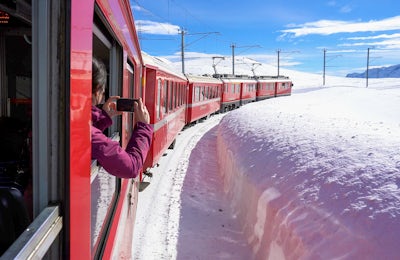
The Bernina Express panoramic coaches represent the pinnacle of scenic railway design. Unlike regular train windows—typically small rectangles at seated eye level—these coaches feature windows that extend from near the floor to the ceiling, curving into the roofline.
The effect is transformative. Rather than glimpsing the Alps through a frame, you're surrounded by them. Mountains loom above you through the curved glass. Valley floors drop away beneath you. The landscape feels immersive in a way that standard trains simply can't match.
Key Features
- Extended glass panels: Windows start approximately 30cm from the floor and extend up and over, curving into the roof
- UV-filtered glass: Reduces glare and protects passengers from Alpine sun intensity
- Climate control: Air conditioning maintains comfort regardless of outside temperature or sun exposure
- Tinted sections: Roof glass is lightly tinted to reduce overhead glare while maintaining visibility
Evolution of Panoramic Coaches
Rhaetian Railway has operated panoramic coaches since the 1980s, but the current generation—introduced in 2006 and updated since—represents significant advancement:
Modern Panoramic Coaches (2006-present)
- Larger window area than previous generations
- Improved air conditioning (essential given the extensive glass)
- Better acoustic insulation
- Modern interior design with comfortable seating
- Power outlets at every seat
- Free WiFi connectivity
Ongoing Improvements
Rhaetian Railway continues to invest in the fleet. Recent updates include improved LED lighting, refreshed upholstery, and enhanced accessibility features. The core panoramic window design remains unchanged—it's already close to optimal.
Panoramic vs. Regular Trains
Here's a direct comparison to help you understand what the panoramic coaches offer over standard RhB trains:
| Feature | Panoramic Coach | Regular RhB Train |
|---|---|---|
| Window height | Floor to ceiling (curved) | Standard (eye level) |
| Roof visibility | ✓ Curved glass extends up | ✗ No overhead viewing |
| Reservation required | Yes (mandatory) | No |
| Opening windows | ✗ Sealed | ✓ Some open |
| Air conditioning | ✓ Yes | Varies by coach |
| Price | Higher (includes reservation) | Standard fare only |
| Route | Same tracks | Same tracks |
📋 Important Note
Regular RhB trains travel the exact same route as the Bernina Express. The scenery is identical—only the window design differs. If panoramic coaches are sold out or beyond your budget, regional trains offer the same journey at lower cost with standard windows.
Maximizing Your Panoramic Experience
Based on multiple trips in these coaches, here's how to get the most from your panoramic journey:
Seating Strategy
Window seats are essential. This seems obvious, but it bears emphasis. The panoramic design is wasted on an aisle seat. Book early to secure window positions.
Single seats in First Class: The 2+1 configuration means one seat per row sits alone by the window. This is the best seat on the train for solo travelers and photographers—views in both directions without leaning over anyone.
Consider both sides: The route twists through mountains, so both sides offer spectacular views at different points. There's no universally "better" side—see our route guide for specific recommendations.
Timing
Morning departures: Generally offer the best light for the most scenic sections (Morteratsch Glacier, Lago Bianco) when traveling southbound.
Avoid midday in summer: Overhead sun creates harsh shadows and can make the curved roof glass act like a greenhouse despite air conditioning. Morning or late afternoon light is more flattering.
What to Bring
- Sunglasses: The extensive glass means lots of light, even with UV filtering
- Light layer: Air conditioning keeps things cool; a light sweater prevents chill
- Camera with fast lens: The glass is good quality but you're still shooting through it
- Dark clothing: Reduces reflections when photographing through windows
Photography Through Panoramic Windows
The panoramic coaches are designed with photography in mind, but shooting through any glass presents challenges:
Minimizing Reflections
- Wear dark clothing—bright colors reflect in the glass
- Cup your hand around the lens to block stray light
- Get the lens as close to the glass as possible (without touching)
- A rubber lens hood can press gently against the glass
Camera Settings
- Shutter speed: 1/500s or faster to freeze train motion
- Aperture: f/5.6-f/8 for sharpness across the frame
- ISO: Whatever needed to achieve fast shutter speed
- Focus: Manual focus on infinity, or tap to focus on distant mountains
The Reflection Problem
Interior reflections are the biggest challenge. In addition to wearing dark clothes:
- Turn off overhead reading lights
- Wait for tunnels to pass (interior lights often brighten in tunnels)
- Shoot when the sun is on your side of the train (external light overwhelms internal reflections)
- Post-process to reduce remaining reflections
📸 Pro Tip
The best "through the window" shots come when the sun illuminates the subject you're photographing but not your side of the train. This creates a brightness imbalance that naturally suppresses reflections.
The Windows Don't Open
An important note for photography purists: panoramic coach windows are sealed. You cannot open them for unobstructed shots. This is necessary for:
- Climate control to function properly
- Passenger safety on the mountain sections
- Noise reduction
If shooting through glass is unacceptable, your options are:
- Break your journey and photograph from station platforms or walking trails
- Take a regional train with opening windows (some older coaches have them)
- Photograph from exterior viewpoints like the Landwasser Viaduct overlook near Filisur
Children and the Panoramic Experience
Traveling with kids? The panoramic coaches are generally excellent for families:
Advantages
- The big windows capture children's attention
- Climate control keeps everyone comfortable
- Assigned seating means no scrambling for spots
- Restrooms are clean and accessible
Considerations
- Four hours is long for young children—bring entertainment for tunnel sections
- The glass gets warm in direct sun—little hands may find it hot
- No opening windows means no sticking heads out (good for safety, sad for kids)
- Snacks help—onboard catering is expensive and limited
Accessibility
Modern panoramic coaches include accessibility features:
- Wheelchair spaces available (book in advance)
- Accessible restrooms
- Staff assistance available for boarding
- Level boarding at major stations
Contact Rhaetian Railway directly when booking if you have specific accessibility needs—they can arrange appropriate assistance.
The Panoramic Premium
Is the panoramic coach worth the extra cost over regular trains? Here's my honest assessment:
Yes, if:
- This is a once-in-a-lifetime trip and you want the full experience
- You value the extended upward views (mountains above you)
- You appreciate the comfort features (air conditioning, modern seats)
- Guaranteed seating matters (regular trains can be crowded)
Maybe not, if:
- Budget is tight—regular trains offer the same route
- You're primarily interested in photography (you'll still shoot through glass)
- You want to hop on/off at intermediate stations (Bernina Express has limited stops)
- You've done the route before and just want to re-experience it casually
Frequently Asked Questions
Yes, the curved glass extends into your peripheral vision even when seated. You don't need to stand to appreciate the extended viewing area. That said, occasionally standing (safely) to look straight up through the roof section is worthwhile at key viewpoints.
The flat side windows offer undistorted views. The curved roof section has minor distortion at extreme angles, but it's not noticeable in normal viewing. For photography, stick to shooting through the flat sections.
The glass is UV-filtered and the coaches are air-conditioned, so it's manageable even in summer. However, direct sun can feel warm on exposed skin. Bringing sunglasses and sitting on the shaded side (when possible) helps.
Both sides offer spectacular scenery at different points. You can also move to vestibule areas between coaches for views from both sides, or stand briefly at key viewpoints. The train isn't so full that you can't move around occasionally.